Short answer: “OPT” on a beauty-machine quotation usually describes a claimed way of shaping pulses within an intense pulsed light (IPL) platform. It does not, by itself, identify a distinct FDA device class, prove that one machine is safer, or establish that a particular indication is authorized in the United States. Compare the exact optical system, its labeled use, pulse data and device record rather than treating OPT and IPL as interchangeable purchasing specifications.
Separate a technology label from the light source
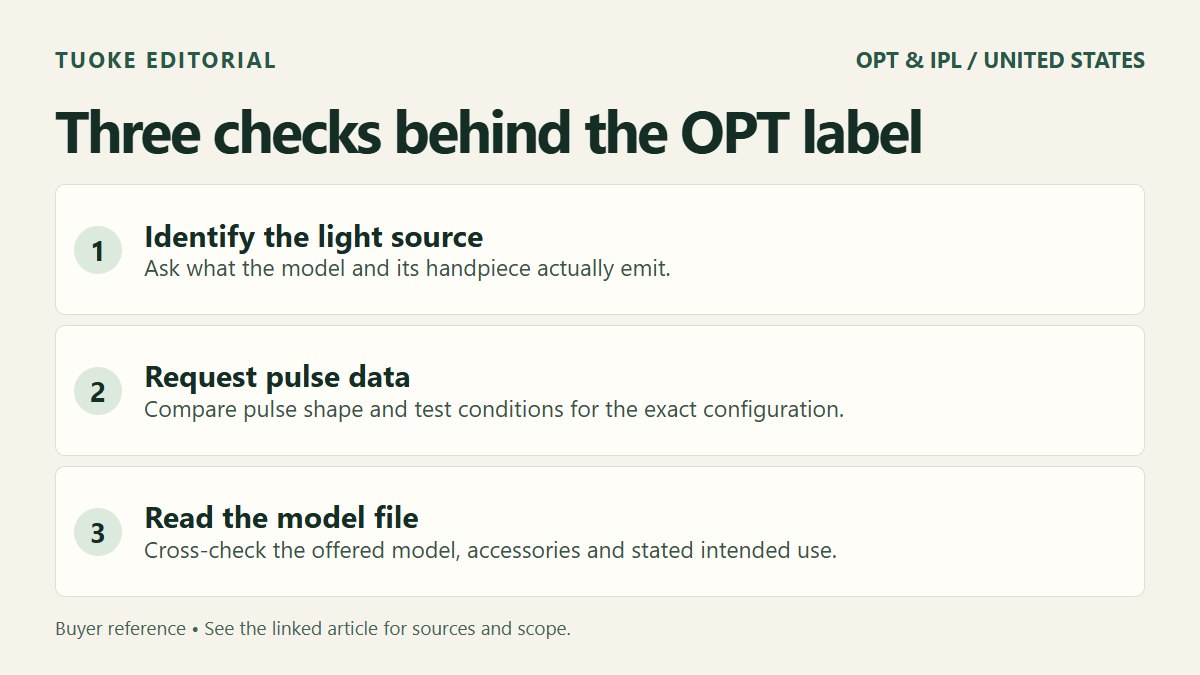
One manufacturer’s technology page describes OPT as “Optimal Pulse Technology” and presents it as an IPL pulse-control approach. That is the manufacturer’s description of its technology, not an independent performance finding for every device advertised with the same letters. The page asserts more uniform energy delivery and gentler treatment than conventional IPL; those comparative claims need evidence for the exact models and settings being compared. A buyer should ask what the supplier means by OPT in its own quotation: a selectable pulse mode, a waveform design, a software setting, or simply a product name.
The FDA’s US product-code ONF classification describes a powered, light-based non-laser instrument with a thermal effect, including broad-spectrum intense pulsed light. Its entry was last updated 19 October 2026. The entry describes a category of devices; it does not certify any machine described in an advertisement as OPT. Likewise, IPL is not a laser because a sales page places the terms together. If a quotation lists “OPT/IPL/laser/RF” as a single technology, ask the vendor to identify which energy source each handpiece actually uses and which functions are included in the quoted configuration.
Ask for a model-specific comparison file
For each candidate device, request the legal manufacturer, exact model and revision, handpiece list, filter or wavelength information, pulse duration and sequence, energy-setting range, cooling method, user manual, maintenance schedule and intended user. A claim that the output is “square” or “stable” should be accompanied by measurement conditions and a test report for the offered configuration, not a diagram copied from a generic brochure. Ask whether the quoted device lets operators select different modes and whether the evidence covers those modes. These questions help procurement staff compare equipment; they are not instructions for choosing treatment settings.
Next, put the proposed application next to the actual US regulatory document. A useful example of what a specific file contains is FDA 510(k) K220385, dated 12 August 2022, for US 500 Intense Pulsed Light Equipment from Beijing Globalipl Development Co., Ltd. Its public summary identifies the manufacturer, ONF product code, prescription-use status, light source, handpiece arrangement and an indicated hair-reduction use. The file is evidence about that named device only. It does not clear a different brand, a different handpiece, an added indication or a TUOKE product. A vendor citing K220385 for another model should be asked to explain the documented relationship and provide that model’s own applicable record.
Compare the entire service, not one pulse claim
Before purchase, have the clinical and safety team compare training, eye-protection instructions, maintenance access, replacement parts, software updates and the terms for service after a fault. A pulse-shape claim cannot answer whether the unit fits the clinic’s intended procedure, staff competence, patient selection, advertising or local operating requirements. Build a comparison sheet with one row for each model and separate columns for documented intended use, measured output, operator controls, risk information and support terms. Mark missing documents as missing rather than filling the cells with assumptions from a competitor’s marketing page.
This distinction also matters for content planning. A page targeting “OPT beauty machine” should answer what OPT denotes and what evidence to request. A separate IPL hair-removal page may address a particular device indication or clinical study. Repeating the same broad benefits under both titles would confuse readers and search engines. For more independent analysis of laser, IPL, LED and RF equipment, see TUOKE’s optical aesthetic equipment buyer guidance. The category is editorial; it does not imply that TUOKE supplies or holds US authorization for an OPT or IPL model.
Sources and limits
- US Food and Drug Administration, product code ONF classification, last updated 19 October 2026; reviewed 24 November 2026. The classification describes a device type, not an authorization for an unspecified model.
- Shenzhen GSD Tech, “IPL (OPT)” technology page, publication date not displayed; reviewed 24 November 2026. Its performance language is the manufacturer’s own claim and is not generalized here.
- FDA, K220385 decision and 510(k) summary, dated 12 August 2022; reviewed 24 November 2026. This is a named third-party device example, not a TUOKE clearance.
This is US-specific procurement analysis, not clinical or legal advice. Device classification, labeling, operator requirements and permissible claims depend on the exact product and intended use.