Full-body red and near-infrared LED beds are among the highest-ticket items evaluated by commercial recovery centers, medspas, and athletic clubs. Marketing brochures often compete on headline LED counts or single peak irradiance numbers, yet those figures tell a buyer very little about thermal reliability, uniform output across the body, eye protection procedures, or regulatory scope. This article provides independent commercial buyer guidance for evaluating full-body optical beds; TUOKE publishes this analysis as an editorial resource and does not claim to manufacture or supply medical photobiomodulation beds.
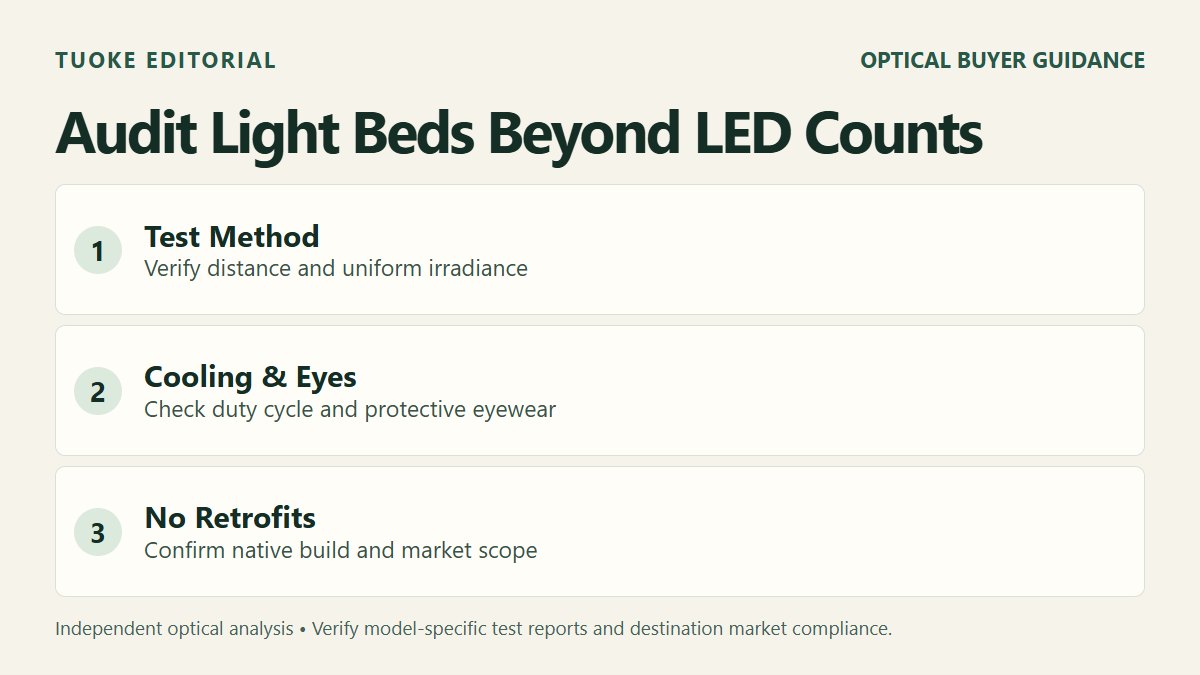
Audit Wavelengths and Irradiance Under Documented Test Conditions
Two commercial LED beds can advertise identical wavelengths and still deliver very different optical output at the user’s skin. Irradiance readings change dramatically depending on measurement distance, sensor type (optical spectrometer versus broadband solar meter), whether the acrylic canopy is installed during testing, and whether the reading was taken at cold start or after continuous commercial operation.
As commercial system makers emphasize in industry technical overviews—such as Prism Light Pod’s bed selection guide and NovoTHOR’s technology overview—engineering consistency matters far more than raw diode count alone. Ask every vendor for a dated test report showing measurement distance, canopy transmission loss, spatial uniformity across head, torso, and legs, and output stability after back-to-back sessions.
Evaluate Active Cooling, Duty Cycle and Noise
High-density LED arrays generate substantial heat inside an enclosed bed chassis. Without properly engineered airflow and heat sinks, junction temperatures rise, LED output drifts downward, component lifespan shortens, and guests experience uncomfortable surface warmth. For commercial facilities planning 10 to 25 sessions per day, ask specifically about rated continuous duty cycle, fan replacement access, filter cleaning intervals, and measured decibel levels inside the suite.
Also confirm room-level HVAC requirements. A high-power commercial light bed rejects heat directly into the treatment room; if the room air conditioning cannot remove that load, both the bed’s internal cooling and guest comfort will suffer during peak hours.
Treat Eye Safety as a Formal Protocol, Not a Blanket Claim
Commercial operators should never rely on casual assurances that high-output LED beds are universally “eye-safe” without protection. Brightness, direct close-range exposure, individual light sensitivity, and photosensitizing medications all affect ocular comfort and risk. In its eye protection guide, ARRC LED highlights why full-body beds differ from low-power consumer masks or distant wall panels and why clear usage rules matter.
Require written photobiological safety documentation applicable to your destination market, confirm what wavelength-matched protective eyewear ships with the unit, and establish a strict cleaning or disposable-eyeshield policy between clients. Post clear signage inside the room instructing guests on eyewear use and contraindication disclosure before every session.
| Evaluation Area | Documented Evidence to Request | Red Flag Requiring Clarification |
|---|---|---|
| Optical Output | Dated spectrometer or lab report stating wavelengths, test distance, canopy status, and multi-point uniformity. | Brochure cites only peak LED count or solar-meter numbers with no test distance. |
| Cooling & Duty Cycle | Rated commercial sessions per hour, heat rejection load, intake filter maintenance, and warranty on LEDs and drivers. | Unit is designed for home intervals or lacks documented continuous commercial duty rating. |
| Eye Protection | Written eyewear specification matched to emitted wavelengths, safety labeling, and client screening protocol. | Sales copy makes blanket “eye-safe” claims without protective eyewear instructions. |
| Build & Retrofits | Purpose-built chassis documentation, electrical safety listing, and confirmation of no converted UV tanning hardware. | Converted tanning bed frames or swapped tubes with altered wiring and unverified safety listings. |
| Regulatory Scope | Written intended-use statement aligned with destination-market rules (e.g., general wellness vs cleared medical claims). | Vendor promises disease treatment outcomes without model-specific regulatory clearance. |
Avoid Unverified Tanning-Bed Retrofits and Overstated Claims
One recurring pitfall in the secondary and budget commercial market is the converted UV tanning bed—a legacy tanning shell fitted with aftermarket red fluorescent tubes or LED strips. As Prism Light Pod’s warning on retrofit tanning beds notes, swapping lamps inside a legacy chassis does not replicate a purpose-built LED system and can raise electrical, thermal, and certification concerns if original wiring or ballasts were modified without re-listing.
Equally important is regulatory positioning. In the United States, the Food and Drug Administration’s General Wellness: Policy for Low Risk Devices (January 2026) outlines the boundary between low-risk general wellness products and regulated medical devices making disease diagnosis or treatment claims. Buyers should keep service marketing strictly inside verified intended-use boundaries for their jurisdiction rather than copying aggressive disease claims from competitor blogs.
If your facility is comparing optical beds alongside thermal wellness pods, infrared capsules, or seated steam units for commercial rooms, you can review TUOKE’s documented thermal and multi-function equipment lineup in the TUOKE wellness capsules category.
Sources
- U.S. Food and Drug Administration (FDA), General Wellness: Policy for Low Risk Devices, final guidance dated January 2026, reviewed 26 November 2026.
- ARRC LED, Is Red Light Therapy Safe for Your Eyes? Eye Protection Guide, published 17 November 2026, reviewed 26 November 2026.
- Prism Light Pod, What To Look For in a Red Light Bed for Effective Treatment, published 13 July 2026, reviewed 26 November 2026.
- Prism Light Pod, Beware of Retrofit Tanning Beds Advertising Red Light Therapy Services and Benefits, published 17 August 2021, reviewed 26 November 2026.
- NovoTHOR, Technology Overview, reviewed 26 November 2026.