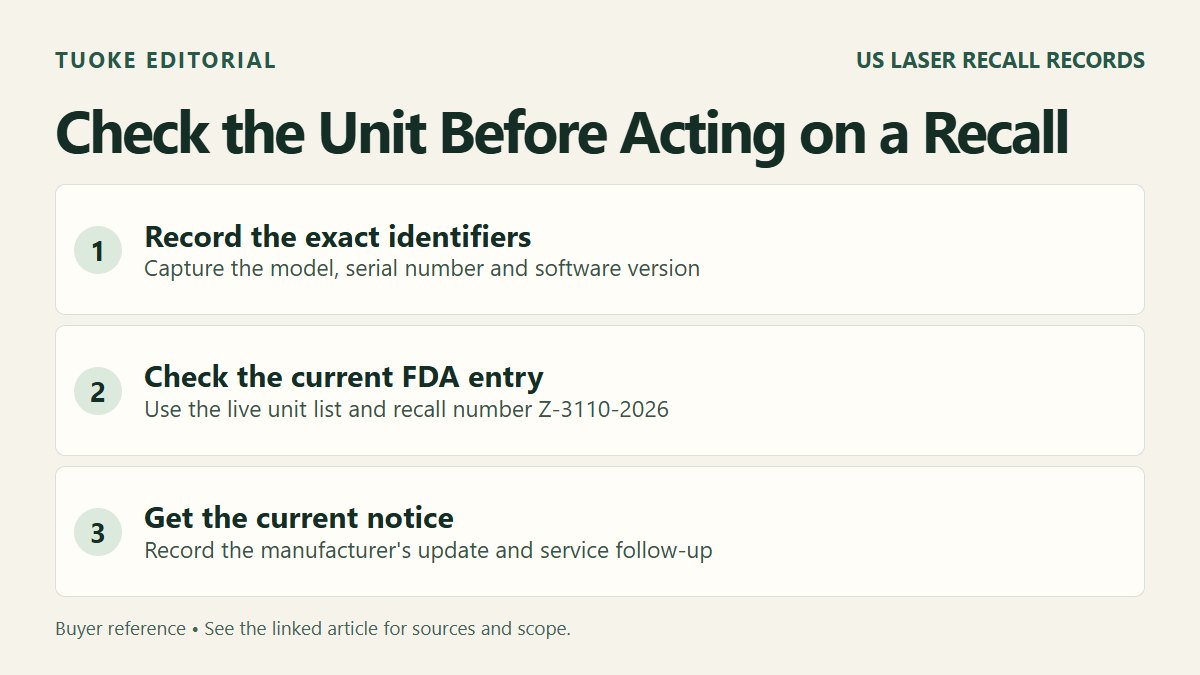
Short answer: A US clinic that owns, services or is buying a DermaV laser should compare the exact model, software version and serial number against the Food and Drug Administration’s recall entry, then obtain the manufacturer’s current notice and revised cryogen parameters through the normal service channel. The FDA record concerns specified DermaV units. It says nothing about TUOKE products, other laser models, IPL, LED devices or radiofrequency equipment. A clinic should not infer that every DermaV unit is covered, or that an unlisted unit is safe for a different reason.
What does the current FDA entry say?
FDA recall Z-3110-2026 identifies a DermaV laser system distributed by Lutronic Corporation. The listed device delivers pulsed laser energy at 532 nm and 1064 nm and may be configured with an Intelligent Cooling Device. The firm initiated its action on 6 August 2026; FDA posted the entry on 4 September. When reviewed on 15 November 2026, the database page, last updated 12 November, marked the Class 2 recall as open, classified. A changing database status is a reason to check the live entry again before acting on an old printout.
The stated concern is specific: using higher fluences at 1064 nm with the then-current cryogen parameters may produce a spark or loud noise during treatment and potentially a patient burn. The FDA entry says the firm began notifying customers and instructed them to stop using the previous parameters and use revised clinical cryogen parameters supplied in its letter. The public entry is not a substitute for that notice or for model-specific instructions. This article does not reproduce treatment settings.
How should an owner check its inventory?
Start with the device’s identifying label and service records. The FDA page lists software version 1.06 and individual serial numbers under its code information. Compare those identifiers exactly, keeping a dated record of the check. A name that sounds similar, or a matching wavelength alone, is insufficient. If a number is unclear, ask the manufacturer or authorized service contact to resolve it; do not guess from the cabinet’s appearance. Confirm whether a unit has already received the revised guidance and whether the clinic’s operators were informed.
The page reports worldwide distribution including the United States and European Union, but this is a US FDA recall record. A buyer elsewhere should also consult the regulator, distributor and service arrangements applicable in its own market. The page lists a quantity in commerce, yet that number is not a count of injuries or of units in any one clinic. A purchaser should request the exact unit history and corrective-action documentation rather than using the aggregate quantity as a risk estimate.
What should procurement and operations change?
For a proposed purchase, put recall status and serial-number verification into the pre-acceptance checklist. Ask who will provide current instructions, train staff on the correction, document software and cooling configuration, and support later safety notices. For an installed unit, preserve the recall letter, the operator acknowledgement and the service or configuration record together. A qualified clinical lead should determine whether any treatment scheduling, patient follow-up or incident reporting needs attention under the actual notice and local procedures. These are process questions, not treatment advice.
The FDA notes that a recall record is created when a firm starts a correction or removal action, and can be updated as classification or termination changes. “Recall” here does not automatically mean every device is physically removed. Nor does the public entry prove that a patient has been harmed at a particular clinic. Avoid repeating the potential burn mechanism as an established local incident or applying it to unrelated brands. This is an equipment-specific safety and purchasing check, not a claim that all aesthetic lasers are unsafe.
Lasers produce coherent light. IPL is broad-spectrum pulsed light, LEDs emit light through a different mechanism, and radiofrequency is electrical energy. Their hazards and regulatory records require separate evaluation. TUOKE’s optical aesthetic equipment research archive provides further independent buyer context; it is not an assertion that TUOKE sells the recalled model. This article is not medical or legal advice.
Source reviewed 15 November 2026: US Food and Drug Administration, “Class 2 Device Recall DermaV,” recall Z-3110-2026; firm action initiated 6 August 2026, posted 4 September 2026, page last updated 12 November 2026. Verify the live record for later status changes.