Budget body contouring consumables from the exact items and quantities the supplier confirms for the purchased configuration. Put recurring stock, periodic replacements and service commitments in separate rows. Learn how much stock must be held before deciding whether a seemingly inexpensive unit makes sense for the intended operation.
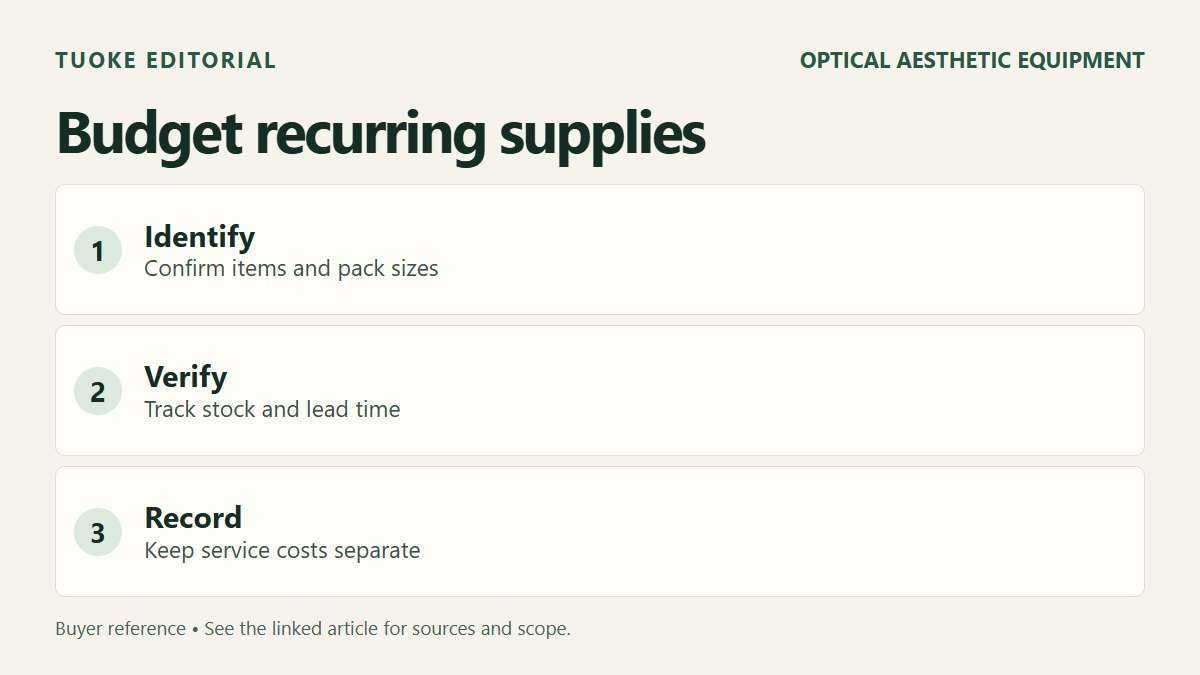
Use named items and actual packaging information
The public FDA K233732 file for a named third-party CoolSculpting Elite application identifies items including a gel pad and pretreatment skin wipe. That gives buyers a concrete example of why a proposal should list items beyond the console and applicator. The file does not establish a general consumables list, pricing or what will be used on every appointment. Get current labeling, applicable documents, availability and written terms for the configuration under evaluation. Do not infer permission to substitute or reuse an item from a similar-looking pack.
For every item ask for the order reference, packaging quantity, price basis, lead time and any storage or expiry limits from the supplier’s documentation. Distinguish items that recur with activity from parts that are replaced as instructed over the life of a machine. Ask who in the clinic checks labeling in case a stock number changes. A catalogue category like accessories may mix items with different purchasing patterns.
Make the calculation checkable
- Unit amount: Divide the quoted pack price by the number of usable order units in the pack, allowing for separate freight or tax as appropriate.
- Forecast: Multiply the confirmed quantity needed for the planning scenario by the unit amount. Keep the quantities that depend on the proposed workflow visible.
- Stock: Record opening stock, reorder lead time, minimum order and how unusable or expired inventory will be counted.
- Service: Record scheduled maintenance, repair coverage and downtime exposure separately from recurring stock.
As an illustration only, a distributor quotes a generic supply item in packs of 12 and your hypothetical forecast needs 17 order units this month. Purchasing must allow for two packs if there is no opening stock, with seven units left over before expiry or stock adjustments. The example describes order arithmetic. It does not establish quantities for any named consumable or clinical procedure. Try a lower and higher stock scenario if the practice has uncertain volume.
Do not make availability a hidden assumption
Ask what happens if the named item is delayed or discontinued and who can approve a documented replacement. Agree a response rather than letting staff improvise. Keep the current item list alongside the stock worksheet and update both when a supplier revises the documentation. This information supports budgeting and inventory decisions. Professional suitability, correct use and product labeling are separate matters for the appropriate team.
Ask the supplier how long it ordinarily takes to confirm whether an order can ship. Order confirmation time and transit time are different fields. If stock is scarce, a purchasing team needs both dates before it can judge the likelihood of a shortfall during the planned period.
See the optical aesthetic equipment resources for related buying questions.
Sources reviewed on 25 November 2026