Short answer: A US buyer considering an AI-enabled wellness assessment feature should first define what the software actually does, then ask how the supplier tests, monitors and corrects its output in the intended consultation setting. NIST’s AI Risk Management Framework (AI RMF 1.0) offers a voluntary way to organize that review through four functions: Govern, Map, Measure and Manage. It is a practical question framework, not a certification, FDA clearance, or evidence that a particular TUOKE assessment product contains AI.
Why start with the exact use case?
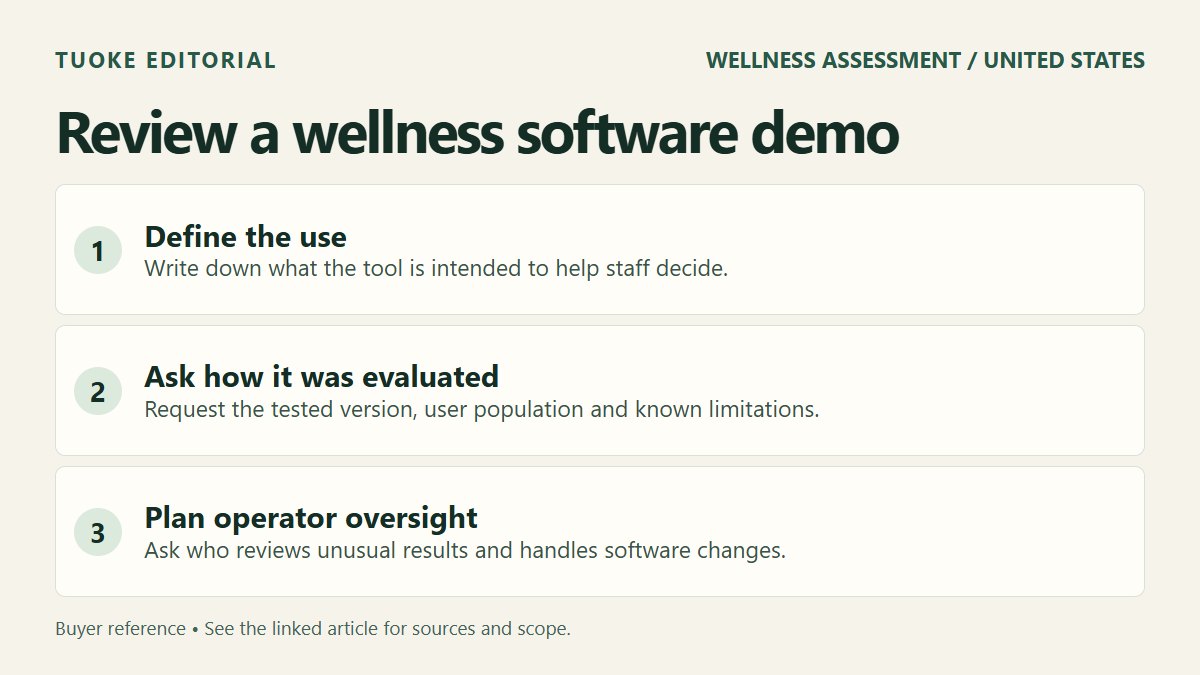
The NIST framework, published on 26 January 2023, is deliberately non-sector-specific and use-case agnostic. It addresses organizations that design, develop, deploy or use AI systems. That breadth is useful for procurement, but a generic claim that a supplier “follows NIST” tells a buyer little about one feature. Ask for a demonstration of the precise input, output and intended user: Does the software summarize a questionnaire, display a trend, recommend a wellness service, or produce a medical-sounding conclusion? Who reviews the output before a client sees it? A feature that only stores answers should not be described as an AI prediction unless the supplier documents the underlying function.
NIST’s Map function emphasizes context, intended purpose, people affected and how use conditions shape risks. In a salon or wellness center, the buyer can turn that into a written workflow: identify what data staff enter, what the system returns, which claims staff may repeat, and when a human should override or decline an output. Specify the client population and languages used in practice. A test result from a different setting or population does not automatically validate a consultation tool.
Four questions for the supplier file
Govern: Who owns the system’s risk decisions? Request the supplier’s version history, responsibilities for updates, incident contact and third-party data or model dependencies. NIST treats governance as a cross-cutting function and explicitly addresses supply-chain risks. A buyer also needs an internal owner: someone who can suspend use, retrain staff and record a concern rather than leaving every judgment to a vendor dashboard.
Map: What are the intended purpose, operating boundaries and foreseeable misuses? Request examples of acceptable and unacceptable outputs. If the vendor markets a feature as a general wellness aid, ask how the interface and sales copy prevent staff from turning an uncertain output into a diagnostic or treatment claim. The NIST framework does not decide whether software is a medical device; intended use and applicable US rules require a separate assessment.
Measure: What testing was done before deployment, and what is monitored later? NIST calls for quantitative, qualitative or mixed methods to assess and monitor AI risk, including regular testing while a system is in use. Ask for relevant validation data, known failure cases, subgroup performance where meaningful, and a process for checking changed model versions. A headline accuracy figure without a defined task, reference standard and test population is difficult to interpret.
Manage: What happens when an output is wrong, inappropriate or disputed? NIST describes prioritizing mapped risks and planning how to respond, recover and communicate after incidents. A buyer can ask for correction procedures, complaint escalation, audit records and a way to stop using the feature while an issue is investigated. Staff should know when to refer a client to a qualified professional rather than using a wellness screen to answer a medical question.
What the framework cannot prove
The AI RMF is voluntary and is not a product-approval register. Its publication date is 2023, so this article is an evergreen buyer interpretation, not a claim of a new 2026 rule. It does not verify any supplier’s training data, security, privacy practices, clinical performance or regulatory status. Those need product-specific evidence and, where health information is handled, a separate data-flow and legal review. The site’s existing US health-data breach guide addresses a different question; a governance checklist cannot replace it.
For documented equipment offerings, start at the TUOKE wellness assessment category and ask which exact model and software features are included. This article does not assert that TUOKE supplies an AI-enabled model or that NIST has endorsed one. It is procurement guidance, not medical or legal advice.
Primary source
US National Institute of Standards and Technology, “Artificial Intelligence Risk Management Framework (AI RMF 1.0)”, published 26 January 2023; the full 48-page NIST report was reviewed 29 October 2026.
Explore Wellness Assessment
Compare equipment formats and request documentation for the exact model and destination market.
Wellness Assessment product category