Treat cold plunge chiller recovery time as two separate buyer tests: initial pull-down from a freshly filled plunge to your chosen test endpoint, and post-refill recovery after a measured partial water replacement. Request evidence using the same test definition for both, and do not compare a supplier’s quoted water-circuit figure with a whole-pool recovery number unless the test conditions match. The practical question is not “which chiller recovers fastest?” but “which supplier can show repeatable recovery under the volume, cover, air and measurement conditions I will actually use?”
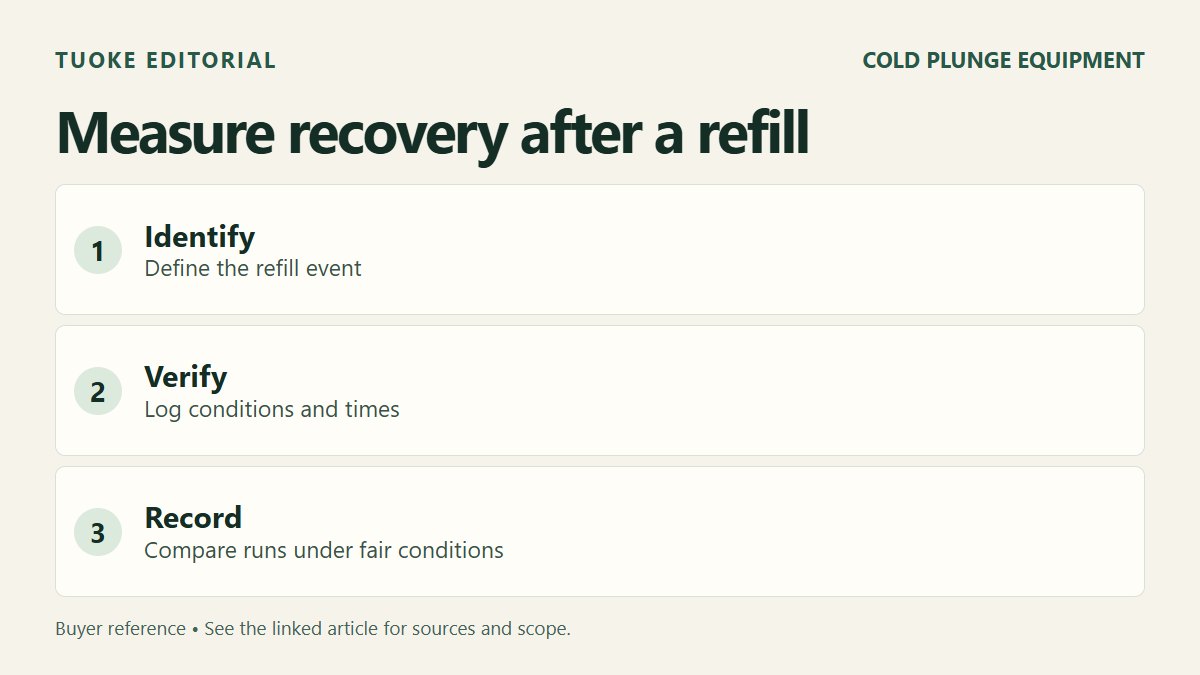
1. Define initial pull-down and post-refill recovery separately
The method below is a buyer test design, not a claim from either named source. Initial pull-down starts with the full plunge volume at a recorded starting reading after filling. For post-refill recovery, record how much water was removed and replaced, the temperature after replacement, and the restored volume. Use the same cover plan and measurement point in each repeat of that test. Record elapsed time from the first stable reading to the chosen end reading. Do not mix a pull-down time from one volume with a refill time from another. A quoted water-circuit figure is not evidence of whole-plunge recovery unless the supplier states the volume, starting and ending readings, cover, air conditions, measurement location and repeat count behind it.
2. Use a worked worksheet, not a single stopwatch number
Hypothetical worksheet: record the installed volume as 400 litres. For a full fill, write down the start reading and timestamp and measure until the agreed bench endpoint. For a partial replacement trial, log the amount replaced, the recovered volume, and the first representative water reading after the system has mixed. Repeat each scenario after returning the installation to its planned starting state. A materially different result calls for a check of the recorded conditions. The worksheet does not prescribe temperatures or claim a rate for any product.
- Actual volume: record litres, not nominal model size.
- Start and end reading: same instrument, same location, same units.
- Elapsed time: start and finish timestamps, not an estimate.
- Air conditions: air reading and sun exposure.
- Cover state: covered or uncovered throughout.
- Measurement location: centre at mid-depth, or another fixed point.
- Repeatability: at least two runs; note spread.
3. Apply a decision rule and respect source limits
Decision rule: only compare recovery times when the test definition matches on volume, starting and ending readings, cover, air conditions, measurement location and repeat count. If a supplier cannot confirm those items, treat the number as an undocumented result and exclude it from whole-system comparison. Request a test result that represents your purchase decision. If vendors report different starting conditions, label the rows as incomparable until they are tested under a shared protocol. Source limits matter. Penguin is a named consumer model example: it lists ambient conditions, insulation and sun effects as relevant, and it explicitly excludes commercial use, so a commercial buyer should not treat it as a commercial recovery benchmark. TUOKE is a named catalog example: model and configuration must be verified, and no model performance should be quoted from the catalog. Use both names as examples of evidence limits, not as rankings or performance promises.
See the cold plunge equipment resources for related buying questions.
Sources reviewed on 25 November 2026
Explore Cold Plunge Equipment
Compare equipment formats and request documentation for the exact model and destination market.
Cold Plunge Equipment product category