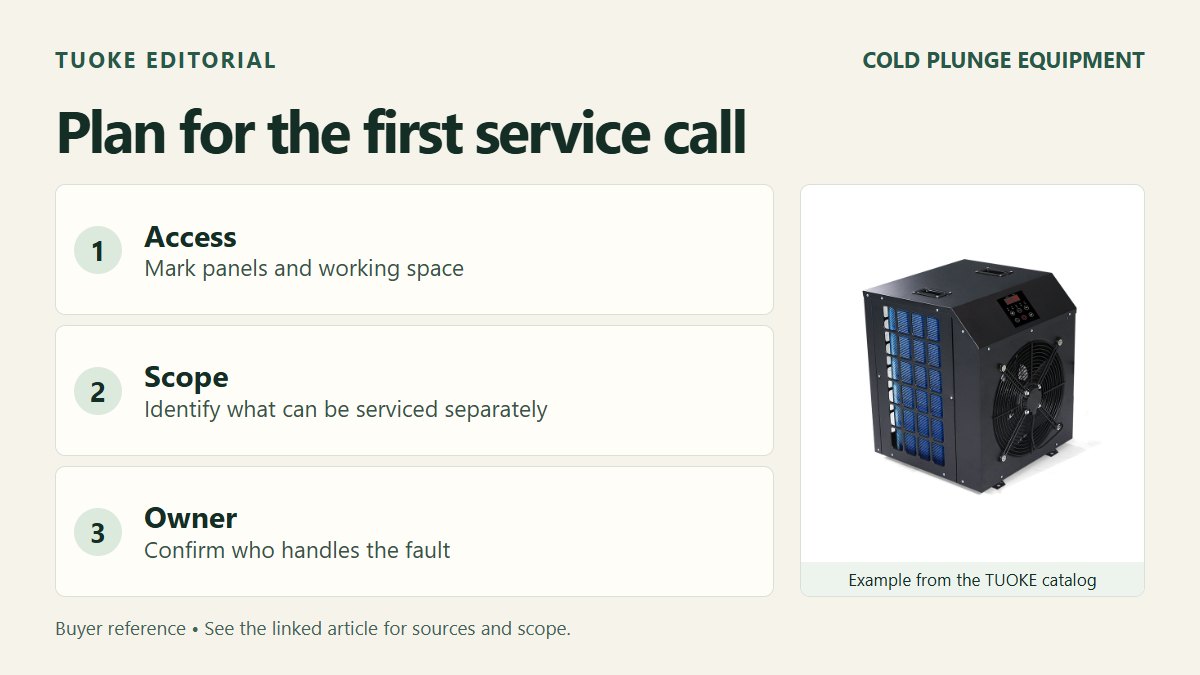
Choose an integrated or separate cold plunge chiller by planning how the equipment will be serviced in the intended space. Ask which parts can be accessed or removed, how much working room each job requires and which supplier handles a fault. Get commercial-use terms for the exact configuration before designing the installation around it.
Five manufacturer listings and what they tell a buyer
The examples below cover commercial, residential and component offers. They illustrate different ways to package equipment and describe servicing. They are not a list of interchangeable commercial systems, and no installation or performance testing was carried out for this comparison.
| Product and source | What the listing shows | Buyer question to resolve |
|---|---|---|
| Plunge All-In Commercial | Plunge lists a commercial configuration separately and describes an easy-access filter and integrated skimmer. | Mark the space for routine filter access and ask who handles a deeper equipment fault. |
| Polar Monkeys Brainpod 2.0 Commercial | The manufacturer describes a modular design with separately accessible pump and chiller components. | Ask the vendor to confirm the approved equipment location, service route and which parties remove and reinstall the modules. |
| Renu Therapy Cold Stoic 3.0 | Renu lists minimum clearances by side, including a large-vent area for access to the mechanics bay. | Put the exact model’s diagram on the room plan and confirm space for both airflow and service access. |
| Ice Barrel 500 | The barrel is offered alone or in a chiller bundle, and the product page lists ports for connection to a chiller. | Identify the exact chiller and the point of contact for a fault involving both vessel and cooling assembly. |
| Penguin Cold Therapy Chiller | The standalone model lists a built-in pump and has a kit option. Penguin explicitly excludes commercial applications for this model. | Use this as an example of a component and use limitation. Ask for documentation for any different model actually proposed for the venue. |
Draw room for a routine service and a larger repair
Put the unit or components on the plan with the maker’s specified vent, panel and working clearances. Then mark the approach needed by the person who will access a filter or remove a serviceable module. Ask whether a technician can handle the larger job in place, must move the tub, or needs a clear return route. Document temporary access through doors and panels as well as the floor space occupied every day.
An integrated package may put routine access and responsibility under one supplier, but a convenient filter door does not establish access to the compressor or pump. A modular offer may make one assembly easier to reach, but its removal still depends on the actual layout and documented service arrangements. If separate sellers supply the vessel and the cooling unit, have them identify which party will investigate a fault where both products are involved.
Walk through an outage before signing the order
Imagine a venue records a cooling fault after commissioning. Ask suppliers to work through the same written scenario without trying to diagnose the unit. Who receives the report and the serial numbers? Which parts can be serviced at the proposed location? If a unit must be removed, who authorizes the work and who verifies that the installation is ready to return to use? Ask for a written answer showing where the product terms stop and installer responsibility begins.
- Access sketch: Record the service locations, open panels, required clearances and the equipment removal route.
- Responsibility map: Name the party for initial support, technical assessment, removal, freight and return to service.
- Use confirmation: Obtain the written offer for the intended setting and ask the responsible people at the venue to verify applicable requirements.
For each quote, mark three checks as documented or still open: routine filter access, the route for removing the largest replaceable assembly and the named owner of the first service call. Attach the drawing or written response to each documented check. If someone predicts a short outage, ask which steps and turnaround times are covered in writing.
Compare offers on the same site plan and the same service scenario. Ask for any missing answers before finalizing the room, and carry the service map into the handover pack. For TUOKE equipment, start with the cold plunge equipment category. For the separate questions of what belongs on the water-circuit quote and how to compare recovery tests, use the corresponding procurement guides.
Explore Cold Plunge Equipment
Compare equipment formats and request documentation for the exact model and destination market.
Cold Plunge Equipment product category