Estimate spa capsule capacity from observed room turnover and available staff minutes. Time the whole cycle from the start of one appointment to the point when the room is genuinely ready for the next. Calculate what fits in the booking window, then check whether the staffing plan can deliver it.
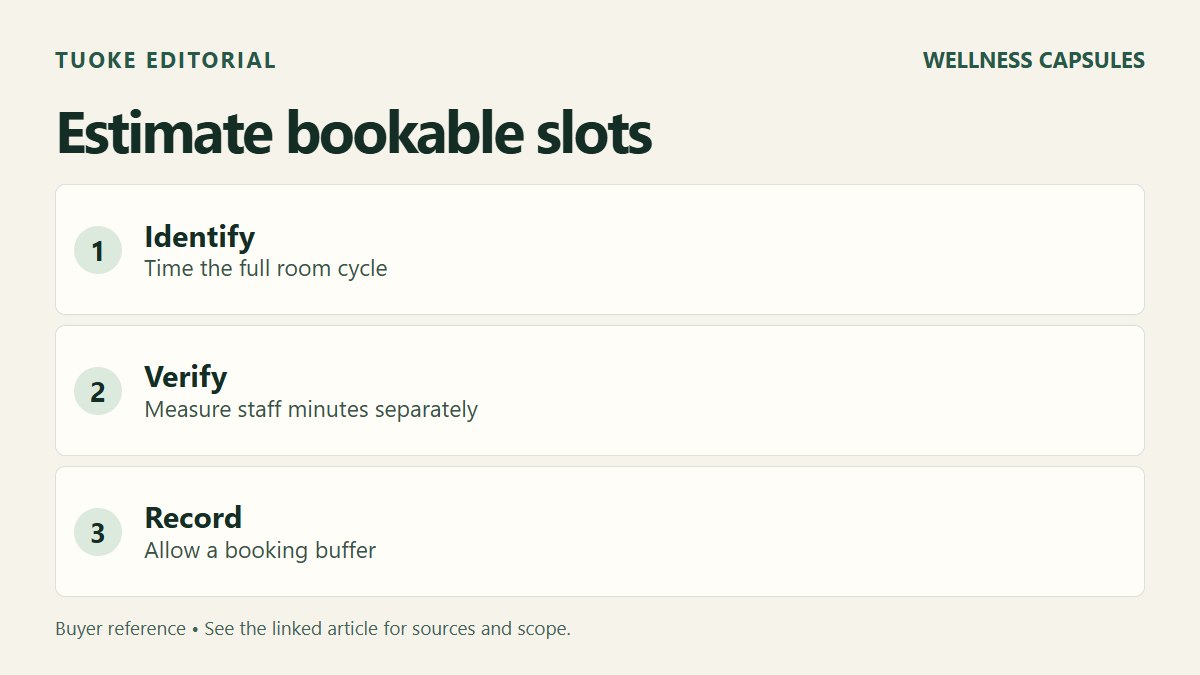
Record a room cycle without changing operating limits
Ask the supplier which instructions apply to the exact unit, then watch a controlled trial of a complete service. Log entry and preparation, the allowed service workflow, exit, and the required reset. The named Spa Capsule manual includes model-specific care for a plumbed design with water collection points. TUOKE’s commercial infrared capsule shows a different layout and directs buyers to confirm its documentation. Neither document supplies a standard turnover time for other machines. Only use tasks and timings appropriate to the unit and venue.
Use two clocks. The room clock shows how long the equipment or space is unavailable for the next appointment. The staff clock adds up the minutes when an attendant is busy with this appointment. A pause during which the room remains occupied may contribute to the first clock without consuming all of the attendant’s time. A shift handover or preparation outside the room may do the opposite. Write down the differences before you add staff or book more rooms.
Make a planning calculation with stated assumptions
Use this worksheet for each day: bookable window, observed room-cycle time, interruption buffer, hands-on minutes per appointment, and available assigned staff minutes. Calculate whole room slots by dividing the usable window by the planned room cycle. Separately test the number of appointments staff can support. Then check that staff time is available at the right moments, particularly when two rooms need resets together.
For illustration, assume a room has 330 bookable minutes and the venue reserves 30 minutes for interruptions. If the observed whole cycle is 50 minutes, that represents six whole room slots. If each appointment needs 15 staff minutes and the rota assigns 75 minutes, the staff budget supports five. Five is a planning ceiling before checking the actual overlap of tasks. These fictional numbers describe a scheduling method, not any equipment’s operating settings or recommended session duration.
Validate the schedule in the real room
Run at least two observations that reflect the intended staffing. Look for delays that could be hidden by an experienced demonstrator. Record whether staff waited for the equipment, a supplies refill, a room another service occupied or a shift handoff. If the delay is recurring, allow for it in the slot rather than expecting the room to catch up later. Put device use restrictions, approved cleaning and routine inspections ahead of the model. A realistic booking plan gives operators more recoverable time and a clear reason to revise their forecast after opening.
See the wellness capsules resources for related buying questions.
Sources reviewed on 25 November 2026
- Spa Capsule owner’s manual, cleaning and maintenance section
- TUOKE Commercial Infrared Sauna Capsule
Explore Wellness Capsules
Compare equipment formats and request documentation for the exact model and destination market.
Wellness Capsules product category