Commercial steam capsules and infrared saunas rarely fail because of one dramatic mechanical event; most premature repairs come from unaddressed moisture, harsh cleaning chemicals, mineral scale, and worn door seals that go unnoticed across busy shifts. Building a simple, logged maintenance routine before opening day protects guest hygiene, preserves surface finishes, and prevents avoidable warranty disputes.
Control Residual Moisture Immediately After Every Session
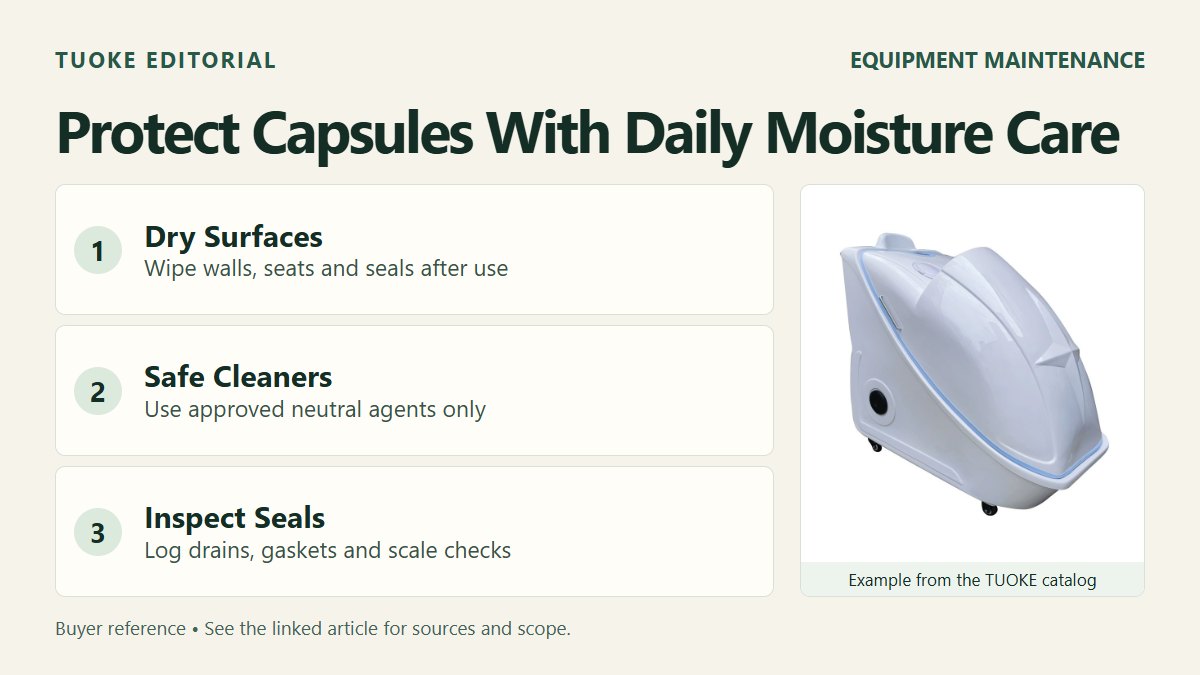
Moisture control is the foundation of longevity for any commercial thermal room. As the U.S. Environmental Protection Agency emphasizes in its Brief Guide to Mold, Moisture and Your Home, preventing mold growth depends on controlling moisture and drying wet surfaces promptly rather than relying on surfaces being “mold-proof.” Even sealed acrylic or fiberglass shells trap condensation around door hinges, seat seams, floor junctions, and adjacent drywall if doors stay closed after a steam session.
Practical steam-room care guidance from commercial wellness manufacturer Jinyukang’s steam sauna maintenance guide underscores the same operational habit: wipe down interior walls, seating, and glass promptly after use so standing water does not pool in corners or grooves, and ventilate the cabinet and room between sessions so relative humidity drops back to baseline.
Use Only Approved Neutral Cleaners and Protect Electrical Zones
Well-meaning housekeeping teams often damage commercial capsules by bringing standard bathroom disinfectants—such as strong acid descalers, high-alkali degreasers, abrasive powders, or undiluted bleach—into the wellness suite. Strong acids and alkalis cloud acrylic panels, dry out silicone door gaskets, corrode stainless trim, and degrade adhesive joints. Similarly, spraying liquid directly onto control pads, display seams, or infrared heater grills creates electrical faults that manufacturers exclude from warranty coverage.
Standardize on a soft microfiber cloth and a manufacturer-approved neutral cleaner, applied to the cloth rather than sprayed directly onto electronics or heating elements. If your facility uses aromatherapy cups or botanical accessories, confirm in writing whether essential oils are allowed in the model’s steam path or reservoir; unapproved oils can leave sticky residue inside valves and heaters.
| Component | Daily / Per-Shift Task | Weekly / Monthly Inspection |
|---|---|---|
| Interior Shell & Seat | Wipe dry after each session; clean with soft cloth and approved neutral cleaner; air out cabinet. | Inspect seams, hinges, and headrests for hairline cracks, discoloration, or trapped moisture. |
| Door Seals & Gaskets | Wipe condensation from seal channels and verify smooth door closure without pinching. | Check rubber or silicone gaskets for hardening, tearing, or steam leaks; order spares early. |
| Steam Generator & Drains | Run documented end-of-day shutdown or flush sequence; confirm drain outlet flows freely. | Inspect supply hoses, drain pan, and fittings for drips; schedule descaling based on local water hardness. |
| Infrared Heaters & Controls | Keep heater panels dry and clear of towels or oils; verify temperature display and timer response. | Check power cord strain relief, breaker condition, and intake vents for dust buildup. |
| Room Ventilation | Run exhaust fan after steam cycles until condensation clears from mirrors and walls. | Clean exhaust grilles, check dehumidifier drain lines, and log room humidity trends. |
Inspect Steam Lines, Drain Pans and Water Hardness Schedules
For steam-equipped capsules, preventive plumbing checks deserve their own line in the weekly log. Commercial steam generator documentation, including ThermaSol’s water supply and drain pan reference, illustrates why operators must keep incoming supply connections, drain pans, and discharge lines distinct and unobstructed. Even a slow pinhole drip inside a service compartment can swell subfloors or trigger electrical faults if nobody checks the service bay monthly.
Test local water hardness during installation and ask the supplier whether an inline water filter or softener is recommended for the steam generator. Hard water accelerates limescale inside heating elements and solenoid valves, raising energy consumption and shortening component life. Record every descaling cycle, filter swap, and gasket replacement in a dated binder or digital log so warranty claims have clear maintenance proof.
Align Maintenance Plans With the Exact Quoted Model
Before finalizing a purchase, request the model-specific care manual, approved cleaning agent guidance, and a spare-parts list for common wear items such as gaskets, fuses, and filters. This checklist is a general operational framework and does not override the manufacturer’s instructions or local electrical and plumbing codes. To review TUOKE’s seated steam equipment format and request model-specific documentation, visit the TUOKE seated steam wellness capsule page.
Sources
- U.S. Environmental Protection Agency (EPA), A Brief Guide to Mold, Moisture and Your Home, reviewed 26 November 2026.
- Jinyukang, Steam Sauna Room Maintenance Methods (蒸气桑拿房保养方法), dated 26 October 2026, reviewed 26 November 2026.
- ThermaSol, Water Supply and Drain Pan, updated 2 June 2026, reviewed 26 November 2026.
- TUOKE Global, Seated Steam Wellness Capsule, catalog reference, reviewed 26 November 2026.
Explore Wellness Capsules
Compare equipment formats and request documentation for the exact model and destination market.
Wellness Capsules product category