Touchless and self-service wellness equipment has become a central selling point for fitness clubs, hotel spas, and recovery lounges trying to add bookable sessions without hiring a full roster of licensed therapists. Industry brands such as Wellsystem highlight automated smart-wellness comfort, while Prism Light Pod’s spa buyer page promotes touchless wellness beds as an add-on revenue stream for resorts and day spas. For commercial buyers, however, “touchless” never means zero operational oversight. A safe, profitable self-service room depends on clear guest controls, reliable emergency release, defined staff response times, and consistent sanitation between bookings.
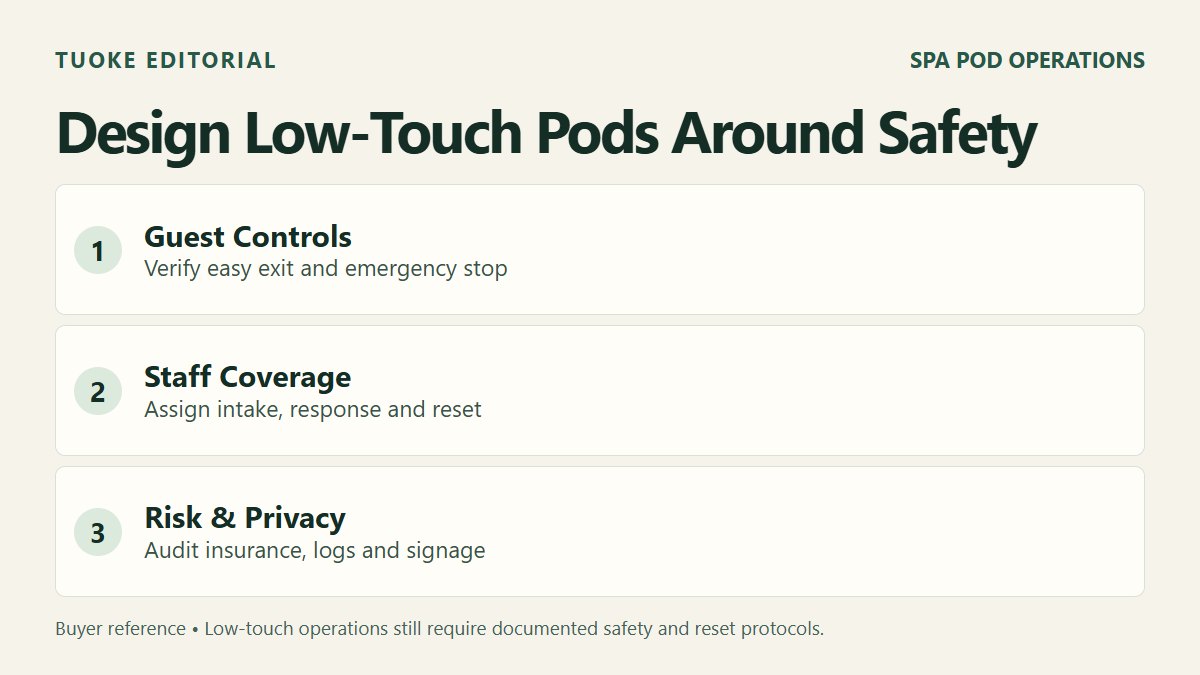
Separate Marketing Claims From Real Staffing Requirements
Equipment brochures sometimes imply that an automated pod runs completely unattended and generates large annual revenue with minimal effort. Treat headline income projections as promotional illustrations rather than guaranteed outcomes, and map every task that still requires a real person on site. Even when a guest starts a preset session alone, someone must handle first-time orientation, verify contraindication acknowledgment, answer a call button promptly, inspect and sanitize contact surfaces between bookings, and lock out the unit if a fault occurs.
Before selecting a pod, decide whether your room operates on a front-desk check-in model (staff brief the guest and start the session remotely or at the door) or a member-access model (pre-oriented members unlock the suite via booking software). Verify that your commercial liability insurer approves the exact supervision level you plan to use.
Audit Guest Controls, Door Release and Emergency Escalation
When a guest lies or sits inside an enclosed or semi-enclosed capsule without an attendant standing beside them, physical usability becomes a primary safety requirement. Under the workplace risk-assessment principles summarized in the UK HSE guidance on electrically powered equipment, operators must verify that equipment is suitable for how it will actually be used and that hazards have clear control measures.
During a pre-purchase demo or factory video inspection, test every control from the user’s position inside the pod. Confirm that the guest can stop the session immediately without needing staff assistance, open any lid or door freely from the inside even during a power loss, and reach a room intercom or panic pull-cord without standing up blindly. Ask the supplier to specify maximum session timers, automatic shut-off defaults, and over-temperature cutoffs in writing.
| Operational Control | What to Confirm Before Launch | Assigned Owner & Verification |
|---|---|---|
| Emergency Stop & Egress | Unobstructed interior stop control, non-latching manual exit, and automatic thermal shut-off verified on the model sheet. | Facility manager tests stop, door release, and power-loss exit during commissioning and monthly checks. |
| Guest Orientation | Short visual wall guide inside the suite plus documented first-visit briefing and wellness screening sign-off. | Front-desk lead records completion in booking software before granting repeat self-service access. |
| Call Button & Response | Hardwired or supervised wireless room alert linked to a staffed desk with a defined maximum response time. | Shift supervisor logs weekly call-button tests and verifies backup coverage during shift handovers. |
| Sanitation & Reset | Written wipe-down sequence, approved cleaner list, fresh liner placement, and buffer minutes between bookings. | Attendant signs off room reset checklist; booking software blocks back-to-back slots without reset time. |
| Access & Privacy | Clear data policy for booking apps, keycard logs, and payment kiosks; no cameras inside private changing or pod rooms. | Operations lead audits privacy notices and restricts access logs to authorized staff only. |
Build Reset Buffers and Data Privacy Into the Room Workflow
Two practical issues often derail otherwise well-equipped self-service suites: tight booking schedules and poorly planned monitoring. If your scheduling system books 30-minute sessions back to back with zero buffer, guests walk into a warm, damp, or uncleaned capsule, eroding trust and hygiene standards. Build explicit cool-down and wipe-down buffers into the booking calendar so staff can reset surfaces properly.
Similarly, resist the temptation to solve unattended supervision with cameras inside private wellness rooms. Keep CCTV restricted to public corridors and entry doors where legally permitted, rely on exterior occupancy indicators and interior call buttons for safety, and verify that any digital check-in or booking portal complies with local privacy laws. Also ensure your guest intake flow clearly frames the pod as a general wellness and relaxation amenity rather than a medical monitoring or treatment service.
Match Pod Architecture to Your Facility Model
Facilities that prioritize easy entry, intuitive preset controls, and rapid between-guest cleaning should compare enclosed and open-front layouts against their exact staffing ratio before signing a quote. This guide outlines operational checkpoints and does not replace legal, insurance, or local regulatory review. To review commercial capsule specifications and request configuration documentation for your facility, see the TUOKE smart wellness capsule product page.
Sources
- UK Health and Safety Executive (HSE), Work Using Electrically Powered Equipment, reviewed 26 November 2026.
- Wellsystem, Smart Wellness Product Overview, reviewed 26 November 2026.
- Prism Light Pod, Red Light Therapy Beds for Spas, reviewed 26 November 2026.
- TUOKE Global, Smart Wellness Capsule, catalog reference, reviewed 26 November 2026.
Explore Wellness Capsules
Compare equipment formats and request documentation for the exact model and destination market.
Wellness Capsules product category