Use a three-part electricity estimate for a spa sauna: startup, active session, and idle. For each phase, multiply the phase wattage by its hours, divide by 1,000 to get kWh, then multiply by your delivered electricity rate. Add any non-energy tariff charges separately. This spa sauna operating cost calculator is only a buying aid: it does not prove savings, and it does not replace a meter reading or your own usage log.
Worksheet and worked hypothetical
The Ohio Consumers’ Counsel electricity fact sheet explains the conversion from watts and hours to kilowatt-hours. Use the arithmetic with your own observations. The sheet’s residential appliance figures are not benchmarks for a spa.
- Use the nameplate rating for an estimated phase if you have no measurement, and explicitly label that assumption. Replace it with measured energy or a justified average phase draw when available.
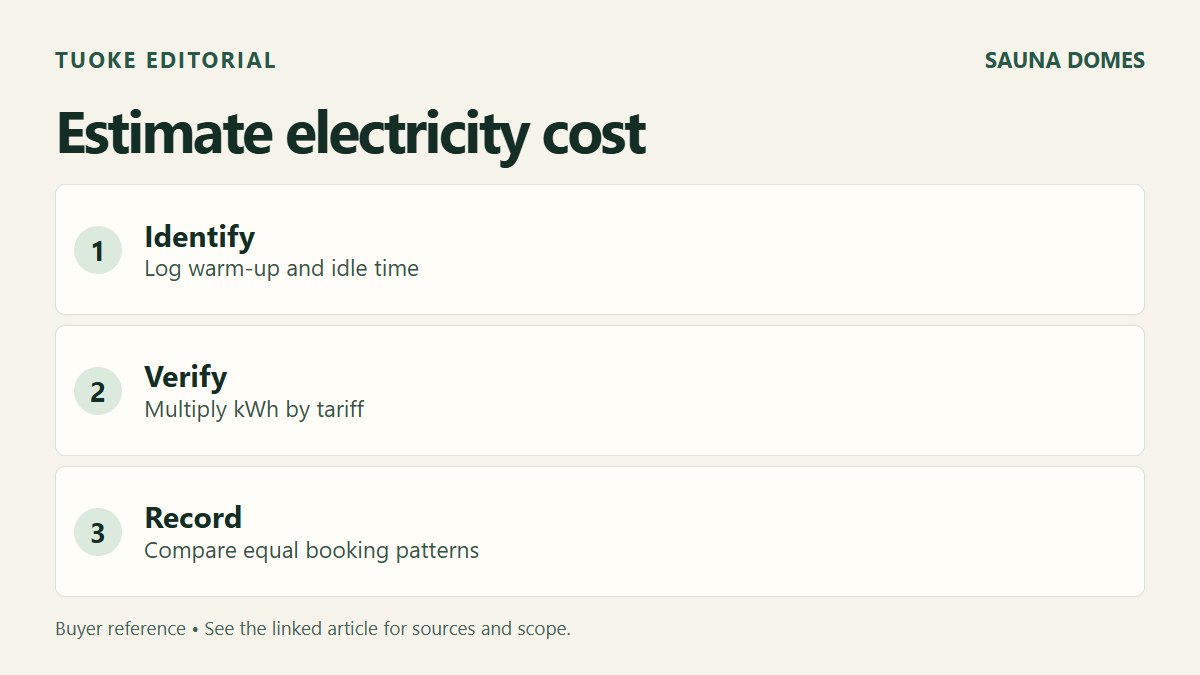
- Log phases for a typical week: startup hours per use, session hours per use, idle hours per week, and uses per week.
- Use phase-specific watts where you have them. Load may vary in use, so a single rated wattage for every hour can mislead.
- Calculate kWh per phase: watts × hours ÷ 1,000. Multiply by your delivered $/kWh.
- Keep fixed fees, demand charges, taxes, and other tariff items in a separate column.
Hypothetical example: an illustration with four booking cycles per week, startup 0.25 hour per use at 3,000 W, session 1.5 hours per use at 3,000 W, and idle 120 hours per week at 300 W. Startup: 3,000 × 0.25 × 4 ÷ 1,000 = 3 kWh. Session: 3,000 × 1.5 × 4 ÷ 1,000 = 18 kWh. Idle: 300 × 120 ÷ 1,000 = 36 kWh. Weekly total: 57 kWh. At a delivered energy rate of $0.18/kWh, energy cost is $10.26 per week, or about $41.04 per four-week period. Other tariff charges are extra.
Compare bookings and idle hours
Ask each quote to use the same phase assumptions: sessions per week, session length, startup allowance, idle hours, and delivered rate. Normalize an omitted idle phase rather than comparing a complete estimate with a partial one. A measured phase log is more useful than a headline wattage: record startup minutes, session minutes, idle hours, and meter kWh for one week, then repeat for a second week if routines vary. Compare equivalent bookings by converting each to weekly kWh and weekly cost. For idle hours, test a low-use and high-use week; the difference shows how sensitive the decision is to standby time.
Decision rule and source limits
Decision rule: prefer the option with the lower normalized weekly energy cost only after both options use the same phase assumptions and the same delivered tariff. If the gap is smaller than your usage and tariff uncertainty, choose on fit and service terms, not on the calculator output alone. Source limits: use site tariff and observations for your estimate. For equipment where ordinary plug-in measurement is unsuitable, ask a qualified person for a metering method appropriate to the installation. This guide does not cover wiring, electrical design, or loads beyond meter-rated use.
See the sauna domes resources for related buying questions.
Sources reviewed on 25 November 2026
Explore Sauna Domes
Compare equipment formats and request documentation for the exact model and destination market.
Sauna Domes product category