Short answer: An EU buyer considering an electric wellness heating mat should establish whether the exact product is electrical and electronic equipment within the relevant waste-equipment rules, who will be the responsible producer in each destination country, and how collection and take-back will work when the mat reaches end of life. The European Union’s Your Europe business guidance describes national registration, regular quantity reporting, collection or financing duties, and the crossed-out wheeled-bin marking. A supplier’s electrical-conformity file does not, by itself, settle these separate waste responsibilities.
What does the EU guidance actually say?
Your Europe explains that manufacturers, distributors and sellers of electrical and electronic equipment in the EU can have duties to help ensure discarded equipment is collected and treated properly. Its summary names registration with the responsible national authorities in countries where equipment is sold, reporting the types and amounts placed on those markets, and organising or financing collection, treatment, recycling and recovery. It also identifies distributor take-back responsibilities. These are general EU-facing descriptions; the practical registration scheme, fee arrangements and implementation details must be checked in each Member State where the product will be supplied.
The companion EU page explains the crossed-out wheeled-bin symbol. It indicates separate collection rather than disposal as unsorted waste. For equipment to which the marking requirement applies, the page describes a permanent, visible and readable mark on the product, together with an identification mark such as a brand or trademark. It gives a limited route to place the mark on packaging or accompanying documents when product size or function prevents marking the equipment itself. A buyer should not infer from a symbol on a draft carton that the correct entity has registered or funded its waste obligations.
Turn the rule into a supplier discussion
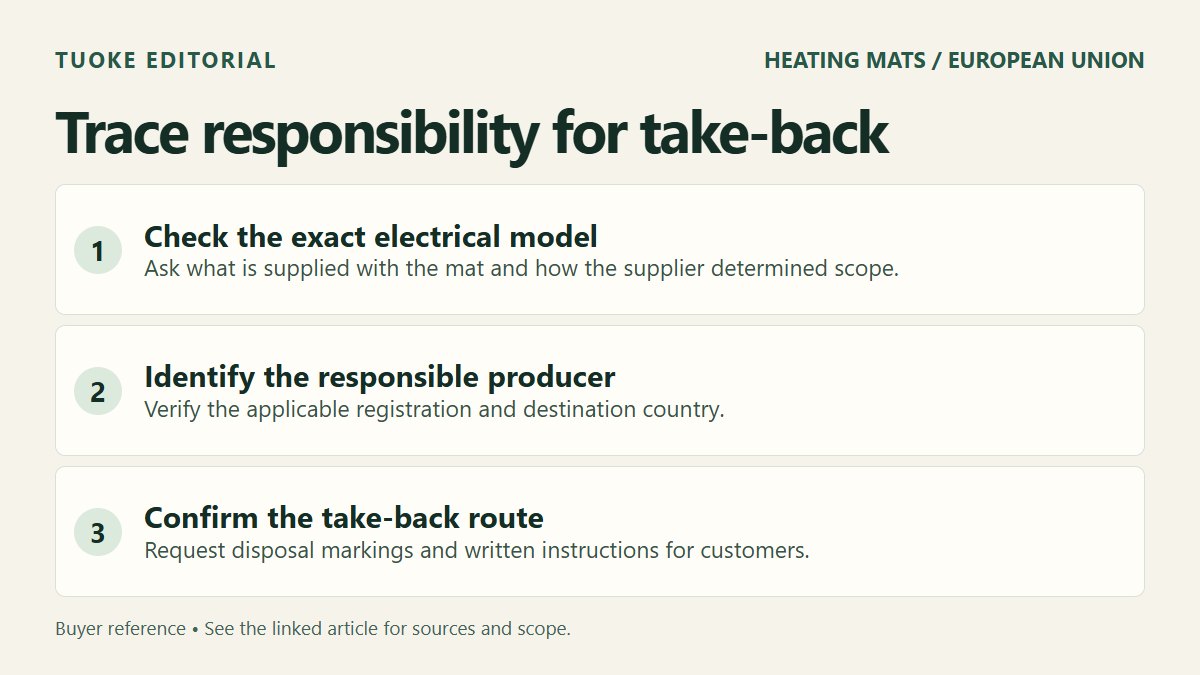
First, ask for a model-specific scope assessment. An electric mat, its controller and any detachable electrical parts may need to be considered together or separately in the product file. Request the model identifier, electrical configuration, intended user and proposed country list. The EU guidance gives broad categories for equipment, but does not classify an unnamed TUOKE mat or decide the boundary for every accessory. A written assessment tied to the delivered model is more useful than a generic statement that all wellness goods are exempt or all have identical duties.
Second, identify who performs the producer role in each market. Private labelling, direct import and local distribution can change the commercial chain. Ask which company will register with each national WEEE authority, provide required reports and pay or arrange the relevant collection scheme. Obtain the registration reference or a documented plan where applicable, and agree who keeps quantity data by destination country. If the buyer is the importer or brand owner, it should check its own obligations rather than assuming the overseas factory has already fulfilled them.
Third, test the customer-facing process. Ask who accepts a used mat, how the customer receives disposal information, and what the distributor will do if a unit is returned. Clarify who handles the controller and other components and whether the proposed take-back channel covers the countries in the sales plan. These operational answers belong in the procurement file alongside labels and contracts; an attractive recycling icon is not a collection service.
What this checklist cannot establish
WEEE is an end-of-life framework, not proof of electrical safety, CE conformity, health benefit or product quality. An earlier TUOKE heating-mat electrical-document checklist addresses the separate Low Voltage Directive question. The present article focuses on waste roles and take-back so that a buyer does not confuse the two files. National rules and the exact product design determine the final legal analysis; this is purchasing guidance, not legal advice or a claim that a particular TUOKE model is registered.
Buyers reviewing a real model can start with the TUOKE heating-mat category and request the precise configuration and destination-market documents before accepting any compliance claim.
Sources
European Union, Your Europe, “WEEE responsibilities”, page marked last checked 12/06/2026; reviewed 26 October 2026. European Union, Your Europe, “WEEE label”, page marked last checked 12/07/2026; reviewed 26 October 2026.
Explore Heating Mats
Compare equipment formats and request documentation for the exact model and destination market.
Heating Mats product category