Short answer: A UK seller should not advertise a sauna blanket’s health result simply because it produces heat or carries a conformity mark. First identify what a reader would understand from the complete advert, then hold evidence for each objective claim before the advert appears. The Committee of Advertising Practice (CAP) says claims can be implied by images and testimonials as well as stated in words. Its medical-device advice also separates an applicable conformity marking from proof that an advertised benefit actually occurs. This is a practical review for a UK-facing sauna-blanket offer, not a finding about any particular TUOKE model.
Start with the promise a buyer actually sees
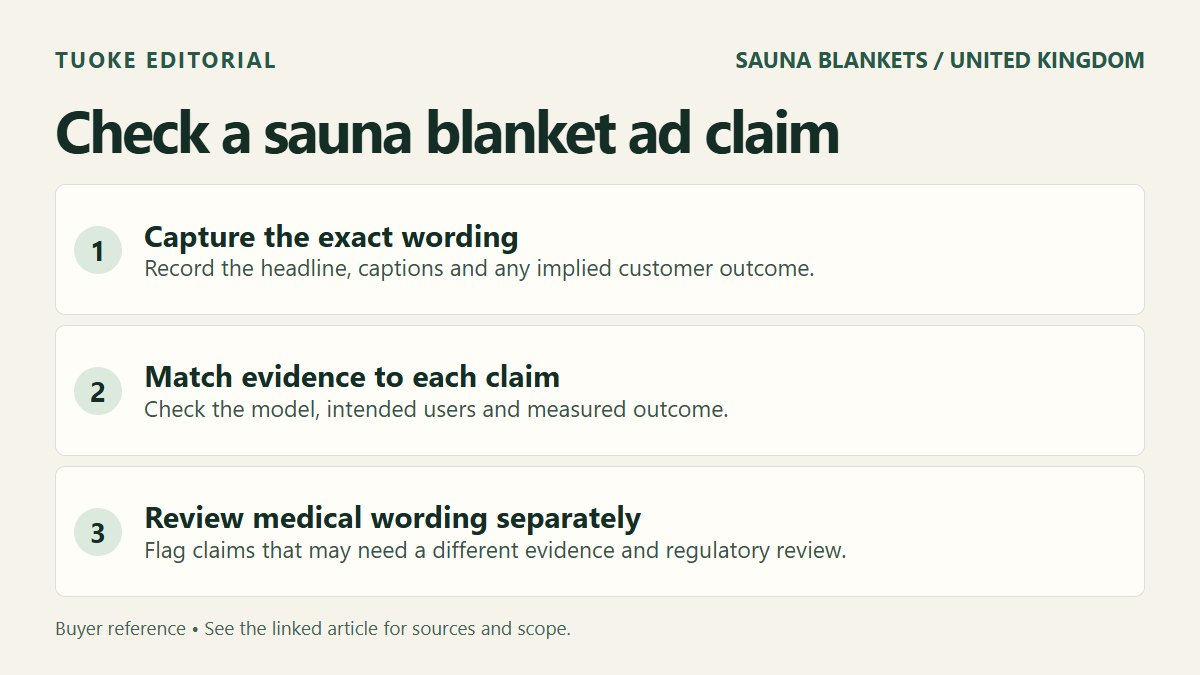
Make a list of the claims in the product page, marketplace listing, brochure, paid advert and social post. Include the headline, images, customer quotations and any claims embedded in a product name. A description of the blanket’s dimensions or the presence of a timer can be checked against the supplied specification. A statement that using it changes a health condition, causes a physiological outcome or produces a measurable result is a different kind of promise. CAP’s 23 June 2025 substantiation advice says the advertiser bears the burden of proof for objective claims, including implied claims, and must have documentary evidence before publication. A disclaimer at the foot of a page does not erase a stronger impression created elsewhere in the advert.
Separate sensory language from testable outcomes. A customer’s description of feeling warm or relaxed is not a clinical result. Conversely, presenting a testimonial about pain relief beside a blanket image can imply efficacy even if the seller did not write the same words in its headline. CAP says the likely takeaway is judged from the perspective of the average consumer. A marketing team should record the interpretation it expects a reader to take away, rather than deciding that a phrase is harmless because it sounds familiar in the wellness industry.
Match evidence to each proposed benefit
For every objective claim, ask the supplier for the precise evidence, the tested product configuration, the studied use conditions and the measured outcome. Keep a version-controlled claim register showing the proposed wording, the evidence owner and the approval date. A test showing that an electrical controller works does not establish that people obtain a health benefit. Likewise, a study of a different heat-based service cannot automatically support an outcome claim for the blanket on offer. If the evidence is missing or does not match the wording, narrow or remove the claim before publishing.
CAP’s substantiation advice distinguishes subjective sensory statements, established objective statements and new or breakthrough claims. It says the evidence needed rises with the nature of the claim, and that new or breakthrough health and beauty claims normally call for a body of sound, relevant data that includes human experimental research. That does not mean every product description needs a clinical trial. It does mean a seller should not use a broad scientific-sounding benefit as a substitute for model-specific proof. The full context, audience and wording matter.
Check the medical-claim boundary separately
CAP’s medical-device advice, dated 29 January 2026, defines medical or medicinal claims as claims about diagnosis or treating or preventing disease, including injury or an adverse condition. It says an appropriately marked medical device may make medical claims within the relevant rules, but marketers still need robust support for efficacy claims. CAP explicitly notes that CE or UKCA conformity evidence is not, by itself, advertising substantiation. A general wellness blanket should not be described as a medical device merely to make a stronger advert, and this article does not classify any blanket. If a UK campaign proposes a treatment or prevention claim, obtain product-specific regulatory and legal advice before using it. Rules for Great Britain and Northern Ireland are not identical, so the destination also matters.
A distributor should ask who controls the final UK-facing copy, who holds the evidence, and whether the manufacturer will supply updated documents if the controller, heating material or instructions change. A spa operator reusing a supplier’s imagery should conduct the same claim review for its own service page. Keep equipment safety and advertising efficacy as separate files: neither proves the other. Do not invent a temperature, certification, medical benefit or customer result when drafting the listing.
Procurement implication and limits
Use the TUOKE sauna-blankets category to identify a candidate product format, then request documentation and approved wording for the exact model and intended UK use. This article interprets CAP’s non-broadcast advertising guidance; it is not legal advice, a blanket-specific ASA ruling or confirmation that a TUOKE product has any medical status. The 2025 substantiation page is background guidance, not a new 2026 policy announcement.
Sources
ASA/CAP, Health: Medical devices, AdviceOnline dated 29 January 2026; accessed 24 October 2026. It explains medical-claim boundaries, conformity marking and the separate need for efficacy evidence.
ASA/CAP, Substantiation for health, beauty and slimming claims, AdviceOnline dated 23 June 2025; accessed 24 October 2026. It addresses implied objective claims, evidence held before publication and differing levels of substantiation.
Explore Sauna Blankets
Compare equipment formats and request documentation for the exact model and destination market.
Sauna Blankets product category